
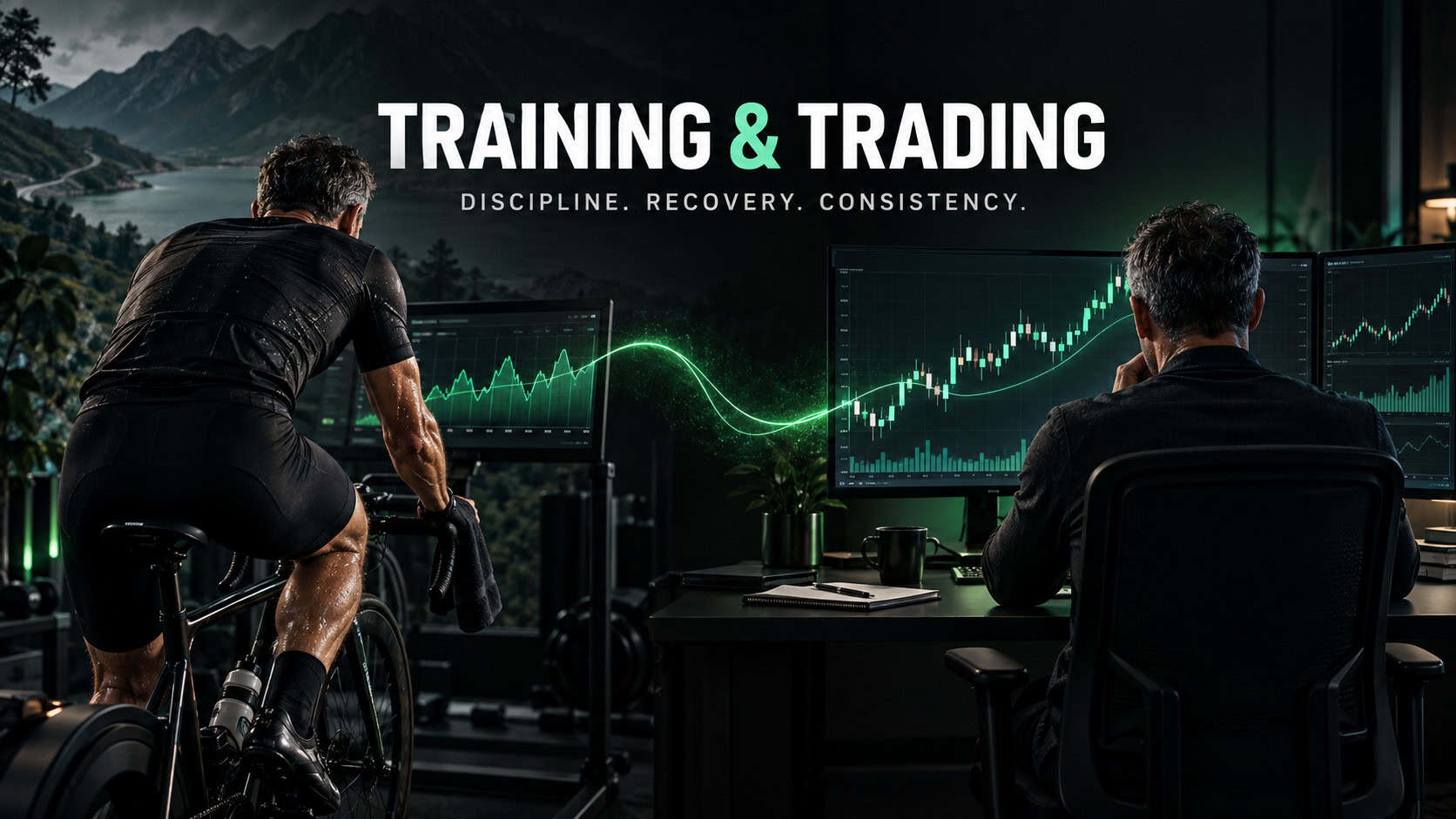
TRAINING, TRADING, AND THE OBSESSION WITH DOING MORE
For some time now, I have had a dream: to finish a Half Ironman.
And yes, I want to do it at 52 years old, without any real background as an athlete—not even as an amateur endurance athlete.
Over the past month, my training has become much more serious and, most importantly, genuinely structured. Naturally, I started reading, researching and trying to understand not only what I should do, but why I should do it.
And almost everyone says the same things:
- Do not make every session hard.
- Follow the structure.
- Respect your recovery.
- Do not increase volume and intensity simultaneously.
- Consistency matters more than one heroic workout.
- Finishing a session completely destroyed does not necessarily mean it was productive.
At first, this felt completely wrong to me.
In my mind, a good workout was one that left me exhausted. If I finished and still felt capable of doing more, I assumed I had not trained hard enough.
Then I realized something:
This is exactly how inexperienced traders think about trading.
1. A Good Workout Is Like a Good Trade
A good workout has:
- a clear objective;
- a defined intensity;
- a planned duration;
- a point at which you stop.
A good trade has exactly the same structure:
- a clear setup;
- a defined entry;
- a predetermined risk;
- a target and an invalidation point.
In both cases, successful execution does not mean doing as much as humanly possible.
It means doing what the plan required.
If my VO₂ max workout asks for five intervals and I complete them correctly, the workout was successful. I do not need another five intervals just because I can still stand.
If my trade reaches its target, the trade was successful. I do not need to immediately enter three more positions simply because the market is still moving.
A completed plan does not become better just because you add more to it.
2. Exhaustion Is the Training Equivalent of Maximum Leverage
In training, you can always push harder.
You can add another interval, another hour on the bike or another session in the evening. You may even survive it and feel proud afterward.
In trading, you can always increase your position size.
You can use more leverage, add another trade or risk more because you feel certain that this time you are right.
Both can produce spectacular short-term results.
Neither is necessarily sustainable.
A workout that leaves you completely destroyed may prove how much suffering you can tolerate, but it does not automatically produce more adaptation.
A highly leveraged trade may produce a huge profit, but it does not automatically represent good trading.
The relevant question is not:
“Could I have done more?”
The relevant question is:
“Would doing more improve the long-term process—or merely increase the risk?”
3. The Last Unnecessary Interval Is Overtrading
This parallel became obvious to me.
You complete the planned workout, but you still feel energetic. So you search for another short session.
“It is only 20 minutes.”
Then those 20 minutes turn out to be far harder than expected. You finish them, but now you have added fatigue that may affect tomorrow’s important workout.
That is overtrading in sportswear.
You take one good trade and close it profitably. You are satisfied, but the market is still open and you are still in front of the screen.
So you look for another setup.
Then another.
Eventually, a disciplined trading day becomes an emotional gambling session—not because the original trade was bad, but because you did not know when to stop.
The ability to continue is not an obligation to continue.
4. Recovery Is Part of the Strategy
This was probably the hardest concept for me to accept.
During recovery, it feels as if nothing is happening.
You are not producing watts. You are not improving your pace. You are not sweating. You are not collecting impressive numbers for your watch.
But recovery is when the body absorbs the training stimulus and adapts to it.
Without recovery, training is only accumulated stress.
Trading works the same way.
Sitting on your hands does not feel productive. You are not opening positions, making money or participating in the market.
But staying out protects both your capital and your mental clarity. It allows you to be ready when a genuine opportunity appears.
Without patience, trading becomes only accumulated risk.
Rest is not the absence of training. It is part of training.
Waiting is not the absence of trading. It is part of trading.
5. Hard Days Must Have a Purpose
Not every workout should be easy.
VO₂ max intervals are hard. Threshold sessions are hard. Long endurance workouts can become hard simply because of their duration.
But difficulty must have a specific purpose.
The same applies to aggressive trades.
Sometimes market structure justifies a larger opportunity. Sometimes the risk-to-reward ratio is exceptional. Sometimes conviction, confirmation and timing align.
But taking more risk simply because normal trading feels boring is not strategy.
Likewise, training until exhaustion simply because an easy day feels unproductive is not discipline.
Intensity is a tool, not an identity.
You are not a better athlete because every workout destroys you.
You are not a better trader because every position terrifies you.
6. Consistency Is Compounding
One heroic workout will not prepare me for a Half Ironman.
One perfect trade will not build a trading career.
Progress comes from hundreds of correctly executed sessions:
- hard workouts when the plan requires them;
- easy workouts when the plan requires them;
- recovery when the body needs it;
- gradual increases in volume and intensity;
- showing up again the following day, week and month.
Trading success is built in exactly the same way:
- taking valid setups;
- controlling position size;
- accepting losses;
- protecting capital;
- avoiding unnecessary trades;
- repeating the process for years.
Everyone admires the spectacular result.
Very few respect the repetitive, often boring process that created it.
Yet that process is where both fitness and wealth are built.
7. Save the Maximum Effort for the Right Moment
At competition, you may empty the tank.
During a Half Ironman, the objective is to use everything you have trained for and cross the finish line.
But training is not the race.
Training exists to create the athlete who will eventually race.
The same distinction exists in trading.
There may be rare moments when an exceptional setup deserves greater conviction. But every ordinary trading day cannot be treated as the opportunity of a lifetime.
Your job is not to prove yourself every day.
Your job is to arrive prepared when the important moment comes.
The Final Lesson
A good workout is not necessarily the one that leaves you unable to move.
A good trade is not necessarily the one that produces the largest possible profit.
A good workout is one that creates the required adaptation without generating unnecessary fatigue.
A good trade is one that exploits an opportunity without exposing the account to unnecessary risk.
In both training and trading, maturity begins when you stop asking:
“How much more can I do?”
And start asking:
“How much is actually necessary?”
Because long-term performance is not built by repeatedly destroying yourself.
It is built through discipline, recovery, risk management and consistency.
At competition, you empty the tank.
In training, you stimulate it and rebuild it stronger.
And in trading, you do not go all-in every day.
You protect your capital, follow your process and allow consistency to compound.

You may also like
Time & Price Delivery: The IPDA Model in Practice

