
Time & Price Delivery: The IPDA Model in Practice
The market doesn’t move randomly.
It delivers price.
In ICT terms, “delivery” means the market moves from one liquidity pool to the next, and along the way it often comes back to rebalance “gaps” (inefficiencies) it created.
This idea is called IPDA (Interbank Price Delivery Algorithm).
To be clear:
IPDA is not a secret code you can see.
It’s just a repeatable behavior pattern you can observe again and again.
In this chapter, we make IPDA practical:
- how to spot delivery
- how to time it
- how to avoid the mental mistakes that make traders become liquidity instead of taking it
3.1 Delivery Is a Sequence, Not a Signal
Most traders are looking for a “trigger candle.”
Smart Money looks for a sequence.
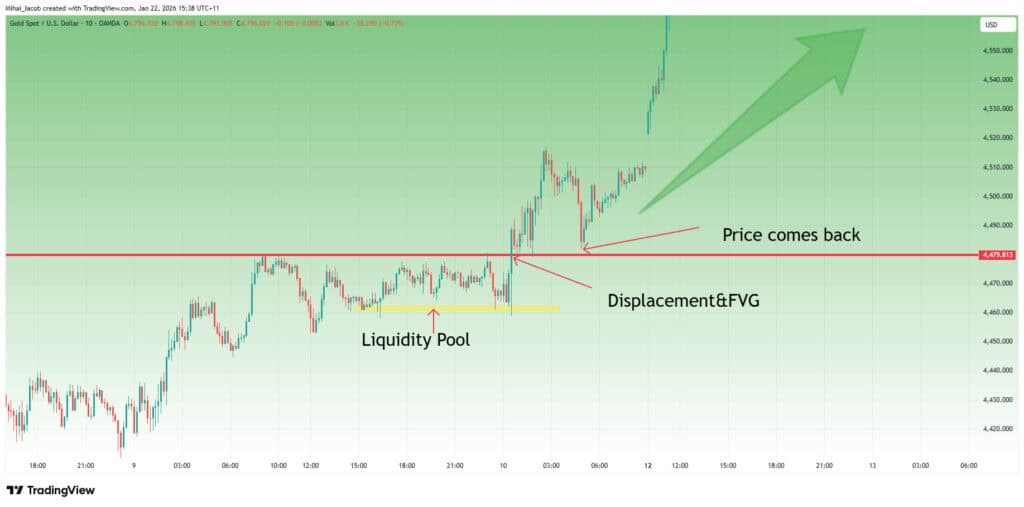
Here is the basic delivery sequence:
- Liquidity forms
(equal highs/lows, obvious support/resistance, trendline touches) - Liquidity raid
(price runs stops above or below a recent high/low) - Displacement
(strong impulse move, usually creates an FVG) - Retracement into a PD Array
(price comes back into FVG / OB / BPR) - Continuation to the next liquidity pool
(delivery completes)
Psychology:
Retail traders want a “perfect entry.”
Professionals wait for the story to unfold.
That story almost always includes:
✅ a raid
✅ a displacement
If those are missing, you don’t have a real setup — you have hope.
3.2 The Three Pillars of IPDA in Real Time
(A) Liquidity = Direction Clue
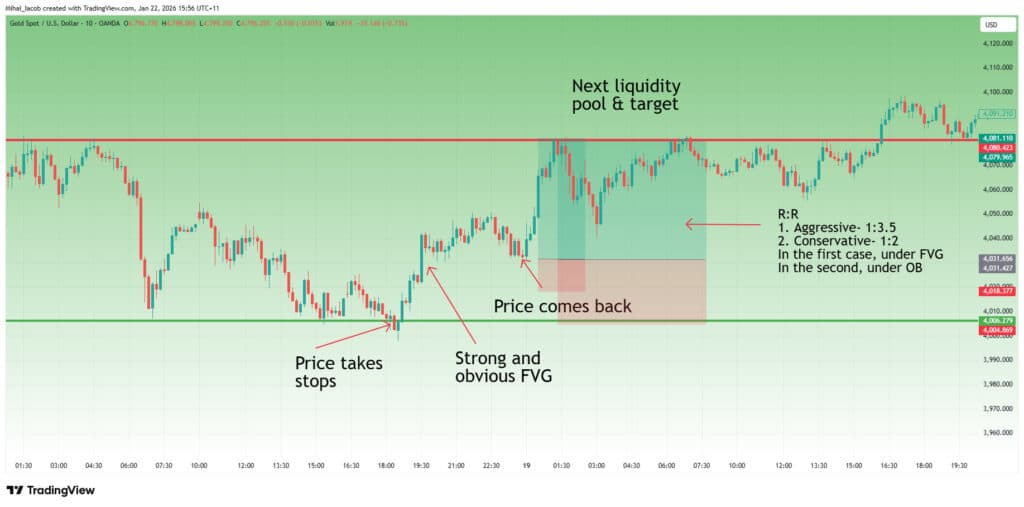
The raid gives you the clue.
Example:
If price takes stops under a prior low (sell-side liquidity) and then rises fast with displacement, that often signals:
👉 bullish delivery
Psychology:
When the market raids against your bias, don’t take it personally.
It’s not “the market attacking you.”
It’s the market collecting liquidity.
The only question that matters is:
✅ Did displacement confirm the new direction?
(B) Displacement = “The Market Left a Gap It Often Comes Back To”
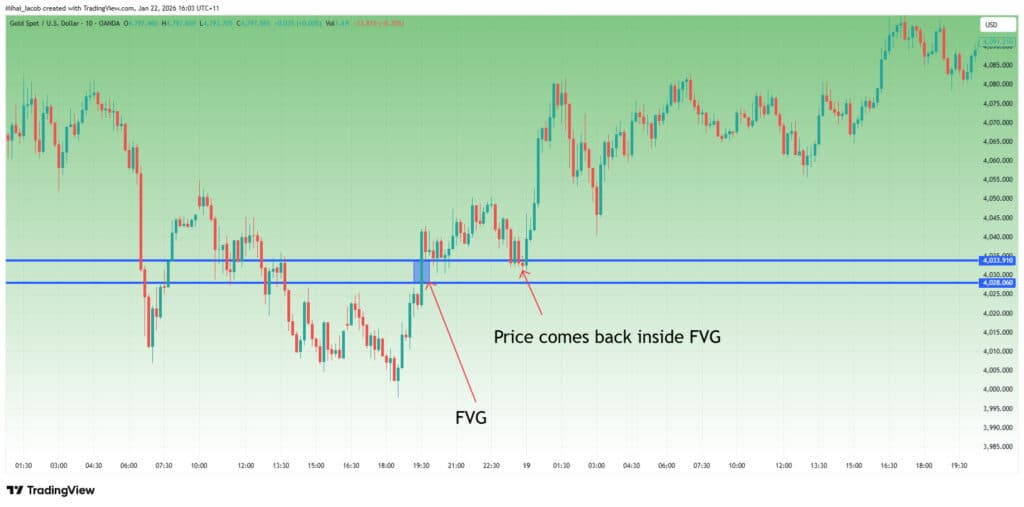
A displacement move usually leaves an imbalance behind.
That imbalance becomes a magnet later.
Two common examples:
- FVG (Fair Value Gap)
A 3-candle pattern where candle B moves so fast that it leaves a “gap” between candle A and candle C. - BPR (Balanced Price Range)
Two imbalances overlap and create a “middle zone” price often revisits.
Psychology:
Many traders chase the impulse candle.
Professionals understand:
“Strong move = likely pullback into the gap.”
This is how impatience becomes discipline.
(C) Retracement = The Entry Moment (Asymmetric Risk)
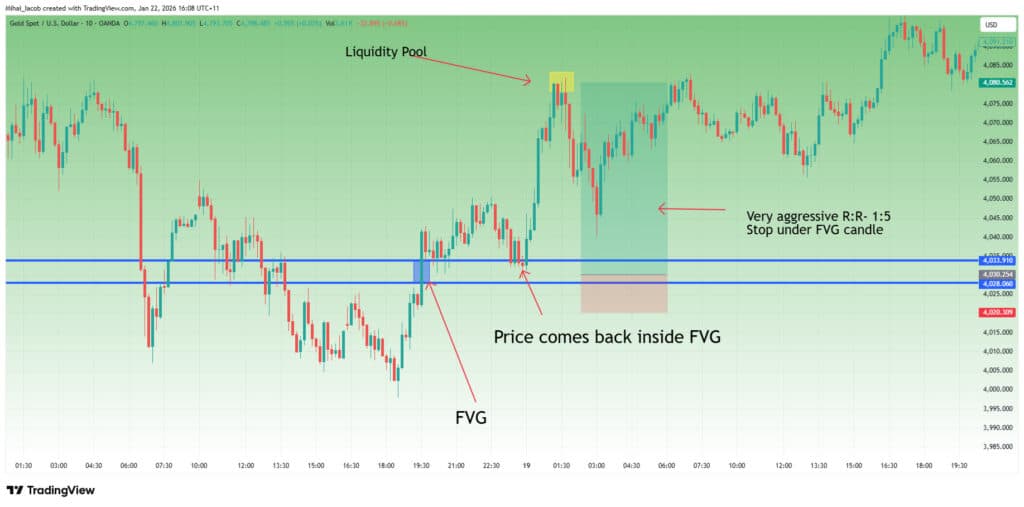
Retracement into a PD Array is where entries make sense, because now:
- the market showed intent (raid + displacement)
- the market created an imbalance (FVG / BPR)
- price comes back into that area
This gives you a clean risk idea:
✅ small stop
✅ clear invalidation
✅ logical target (liquidity)
3.3 MSS vs BOS: How to Read the Turn
Two important terms:
- MSS (Market Structure Shift)
A fast local change, often the first sign that direction is changing. - BOS (Break of Structure)
A stronger confirmation, usually slower and more obvious.
Simple rule:
✅ For execution: MSS is enough on your lower timeframe if HTF context supports it
✅ For overall bias: wait for BOS on M15/H1 (or higher)
Psychology:
If you wait only for BOS, you often enter too late.
If you enter too early (no shift), you get trapped.
The “middle path” is:
✅ MSS inside a PD Array, inside the right higher timeframe context.
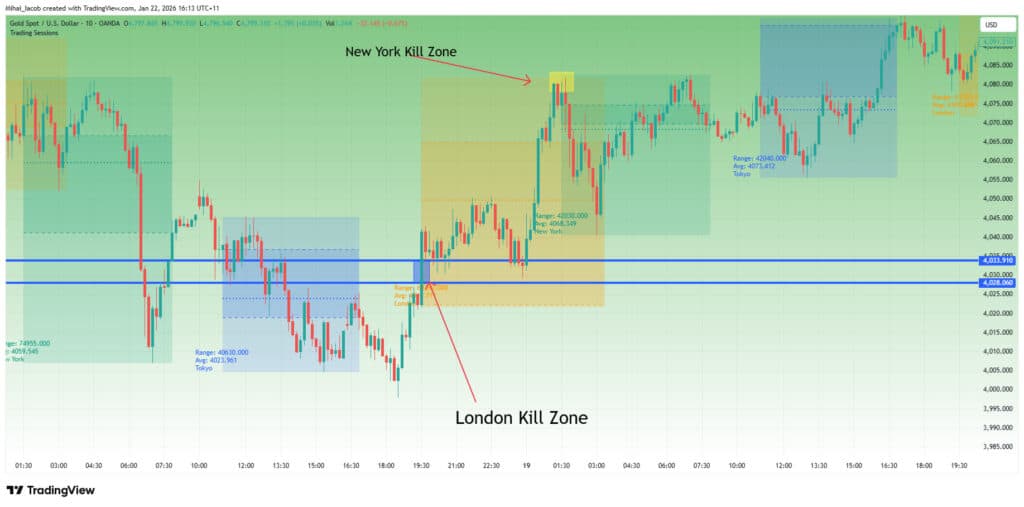
3.4 Time-Conditioned Delivery (Sessions & Kill Zones)
IPDA is not only price-based.
It is also time-based.
The highest probability moments usually come during:
- London Kill Zone (07:00–10:00 UK)
Often creates the raid + early delivery - New York AM Kill Zone (12:30–15:00 UK)
Often confirms the day’s real move (or flips it) - New York PM (18:00–20:00 UK)
Often smaller moves or rebalancing
Psychology:
Trading outside strong hours drains your mind and your account.
Trade when the market moves.
Let time filter the noise.
3.5 Internal vs External Liquidity (What Are You Targeting?)
Liquidity comes in two types:
Internal Liquidity
Inside today’s range:
- equal highs/lows
- minor swing points
- intraday stops
External Liquidity
Outside the range:
- yesterday high/low
- weekly highs/lows
- major previous extremes
A very common delivery behavior is:
- raid internal liquidity
- then deliver to external liquidity
Psychology:
Many traders take profit at “nice numbers” because it feels safe.
Professionals ask:
“Is that an actual liquidity pool?”
Comfort targets are not algorithm targets.
3.6 The Delivery Ladder: Multi-Timeframe Alignment
To trade delivery correctly, each timeframe has a job:
HTF (D1 / H4)
- defines big range
- defines premium/discount
- defines major PD Arrays
MTF (H1 / M30)
- shows displacement
- shows MSS and structure direction
LTF (M15 / M5)
- gives precise entries inside the PD Array
Psychology:
This removes mental chaos.
You stop forcing M5 to answer big-picture questions,
and you stop using D1 to pick exact entries.
3.7 When Delivery Stalls (When NOT to Trade)
Red flags:
- displacement without a raid first
- retracement happens outside session windows
- entry would be into the wrong HTF zone
- H1 bias and M15 structure are fighting each other
Psychology:
The urge to “be active” is expensive.
Professionals are paid for selectivity, not activity.
3.8 Practical Entry Blueprint (IPDA-Aligned)
(Bullish example — bearish is the mirror)
- D1/H4 is in discount
- London raids sell-side liquidity below a recent low
- MSS + displacement happens up (M15/M5) → FVG forms
- Price retraces back into the FVG during kill zone
- LTF confirms MSS (M1/M2) → enter
- Target external buy-side liquidity (yesterday high / session high)
3.9 Risk & Management Synced with Delivery
Simple risk rules:
- Stop-loss: beyond the swing that created displacement (not inside the FVG)
- Scaling: only if structure continues with a new MSS
- Partials: near internal liquidity (or mid-range)
- Final exit: external liquidity OR opposing PD Array
Psychology:
Taking partials is not fear.
It’s syncing your money management with the market’s delivery steps.
3.10 Mindset Upgrade: Stop Predicting, Start Following Delivery
You don’t need to predict the market.
You need to follow the sequence:
✅ Wait for the raid (shows what price is hunting)
✅ Demand displacement (shows direction)
✅ Enter on the pullback into the FVG (best risk point)
✅ Target liquidity (delivery completion)
This is trading with the algorithm — not against it.
Chapter 3 — Summary
- IPDA is a repeatable sequence, not a one-candle signal.
- Raids show intent. Displacement creates imbalance. PD Arrays offer entries.
- Time matters: kill zones filter noise and raise probability.
- Align HTF bias → MTF structure → LTF execution.
- Manage risk using internal and external liquidity checkpoints.
- The psychological edge is patience with a plan — not activity with hope.
✅ Chapter 3 — Quick Read / Cheat Sheet (Simple Version)
Time & Price Delivery (IPDA) — What You Need to Remember
1) The market moves for liquidity
Price doesn’t “wander.”
It moves to:
- grab stops (liquidity)
- rebalance gaps (FVG)
2) Delivery happens in a clear sequence
Most high-probability moves follow this order:
- Liquidity forms (equal highs/lows, obvious levels)
- Raid (stops get taken above/below)
- Displacement (strong move + FVG appears)
- Retrace (price comes back to FVG)
- Continue (price runs to the next liquidity pool)
✅ No raid + no displacement = usually no trade.
3) Raid tells you the direction clue
- Raid above highs + strong move down → bearish intent
- Raid below lows + strong move up → bullish intent
The raid is the “trap.”
Displacement is the confirmation.
4) Displacement creates an “obligation”
Strong displacement leaves an FVG.
Price often revisits:
- FVG
- 50% of FVG
That’s why we don’t chase impulsive candles.
5) Our entry is always FVG
✅ Entry = FVG retracement (preferably 50%)
✅ Stop = beyond H4 Order Block (invalidation zone)
✅ Target = liquidity (highs/lows)
One entry model = no confusion.
6) MSS vs BOS (simple rule)
- MSS = early turn (fast confirmation on lower TF)
- BOS = stronger confirmation (slower, higher TF)
✅ Use MSS for entries inside FVG
✅ Use BOS for overall bias confirmation
7) Trade during kill zones
Best hours for real moves:
- London Kill Zone
- New York AM Kill Zone
Outside these windows = lower probability = more noise.
8) Internal vs External liquidity
- Internal = inside today’s range
- External = outside the range (PDH/PDL, weekly highs/lows)
Market often raids internal first, then delivers to external.
9) Multi-timeframe ladder
- H4/D1 → defines bias & zones
- M30/H1 → shows structure
- M5/M15 → executes entry
Each timeframe has one job.
10) The pro mindset
Don’t predict.
Follow the sequence:
✅ Raid → Displacement → FVG entry → Target liquidity
That’s trading with delivery, not with hope.

You may also like


Why Smart People Struggle with Trading
